Dato: Sunday, 3. mai 2026 kl 14:00
Sted: Litteraturhuset
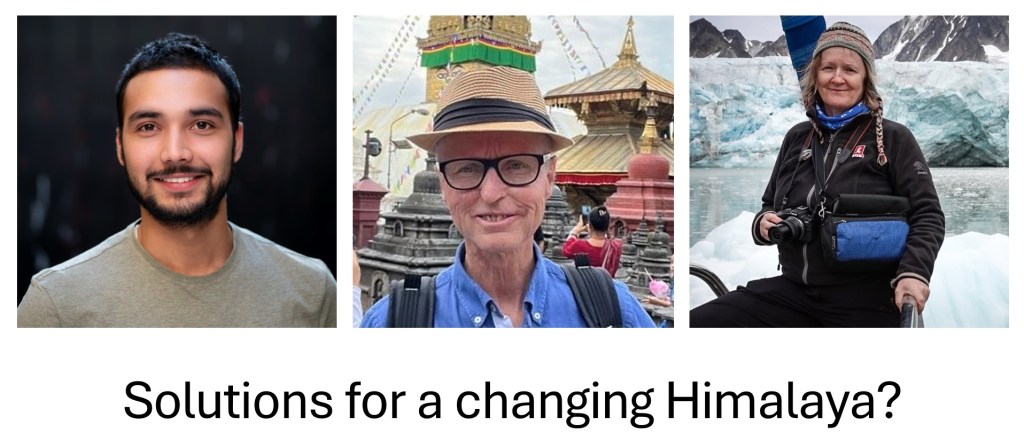
Climate change is already affecting the Himalayas – but what can actually be done? What solutions exist, and how can policymakers and communities work together?
Join us for an open event where you will meet experts who have worked with climate, glaciers, and mountain communities in the region for many years.
Welcome to an event that lifts our gaze toward the world’s third pole.
IVAR JØRGENSEN
He has been involved with environment, livelihoods, and climate change in Nepal and the Himalayas for 40 years. In his first assignment in Nepal in 1986 – 88 he worked for environmental protection in the Shivapuri Watershed just outside Kathmandu. Shivapuri later became a national park. Since then, he has visited Nepal and the other Himalayan countries frequently, in many different capacities.
He currently serves as member of the board of Directors of ICIMOD (the International Centre for Integrated Mountain Development), headquartered in Kathmandu, as a member of the Programme Advisory Committee, and as chair of the ICIMOD evaluation committee. He retired from his post as Policy Director for climate and environment in Norad in 2023.
MIRIAM JACKSON
Dr. Miriam Jackson is a glaciologist and climate scientist with wide experience from High Mountain Asia, the Arctic, and the Antarctic. In the Hindu Kush Himalaya, she worked with the Bhutanese government to establish its first glacier mass balance programme, led the joint Norway-India research project INDICE on climate change and hydrology, and spent several years at the International Centre for Integrated Mountain Development (ICIMOD), where she led the cryosphere work including the establishment of permafrost measurements in Humla, western Nepal. Miriam has also worked on the societal implications of changes in the cryosphere, working together with both policymakers and local communities.
SURAJ GHIMIRE
He is a data analyst and researcher with experience in disaster management and community development, including work with the Nepal Red Cross. His earlier master’s research in sociology examined how the 2015 Nepal earthquake influenced international labour migration and household vulnerability. His recent research at the University of York uses data analytics and machine learning to analyze flood patterns and human impacts in South Asia.
Suraj will present insights on how disasters shape human vulnerability and migration patterns. Drawing on historical disaster data and machine learning, the presentation explores flood risks and human impacts in South Asia, particularly in regions influenced by Himalayan river systems.
 Norge-Nepalforeningen