Nepal through a lens: from Paddy field to Queer lives

RSVP to the event on Facebook

STUDENTER PRESENTERER

De siste årene har fotojournaliststudenter ved Oslo Met reist til Nepal for å gjøre prosjektarbeid. Reisen er fast innhold på studiets siste år, og dette er studentenes avsluttende oppgave på bachelorutdanningen. Resultatet av prosjektene er mange individuelle presentasjoner og en bildebok.

På denne Nepalkvelden presenterer to av fjorårets studenter sine prosjekter:

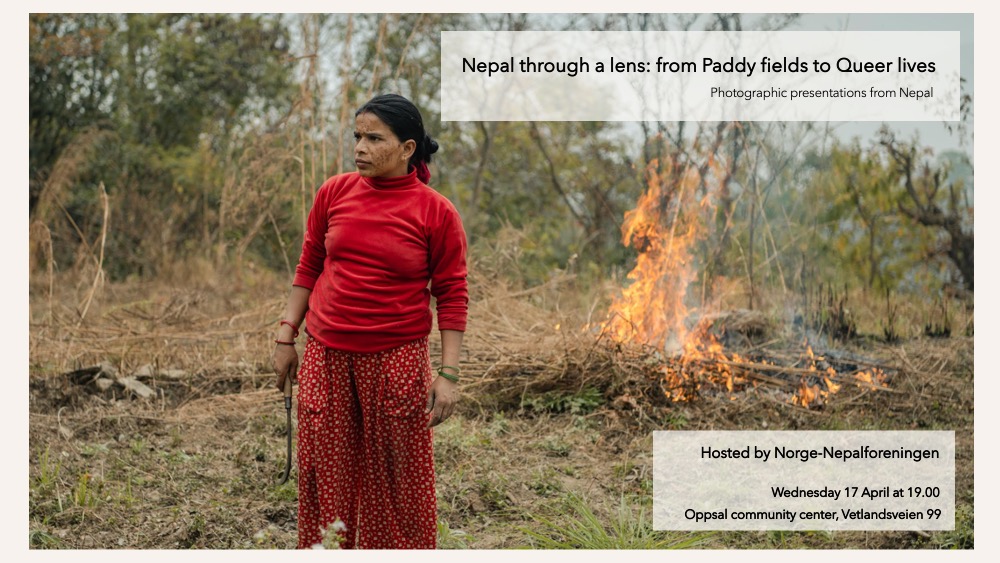
  • Isabel Svendsen Berge har laget en konseptuell fotoserie som tar for seg hvordan det er å være skeiv i Nepal. Prosjektet belyser også HIVs rolle blant landets LGBTQ+ befolkning, hvor så mange som 10-14% er smittet.
  • Martin Solhaug Standal sitt prosjekt handler om gårder i Nepal. Flere og flere gårder blir forlatt. Samtidig er landets økonomi avhengig av landbruket, som bidrar mest til BNP.

Tidspunkt: Onsdag 17. april kl. 19.00
Sted: Oppsal samfunnshus, Vetlandsveien 99.
Ankomst: med T-bane til Oppsal T eller buss til Oppsal senter. Gateparkering for dem som kommer med bil.

Arrangementet gjennomføres på engelsk.

Velkommen til en kveld hvor det settes lys på viktige samtidstemaer i Nepal!


STUDENT PRESENTATIONS

In recent years, photojournalism students at Oslo Met have traveled to Nepal to do project work. The trip is a regular part of the final year of study, and this is the students’ final assignment on their bachelor’s degree. The results of the projects are many individual presentations and a book with photos.

At this event, two of last year’s students present their projects:

  • Isabel Svendsen Berge has created a conceptual photo series that looks at what it’s like to be queer in Nepal. The project also shed light on the role of HIV among the country’s LGBTQ+ population, where as many as 10-14% are infected.
  • Martin Solhaug Standal’s project is about farms in Nepal. More and more farms are being abandoned. At the same time, the country’s economy is dependent on agriculture, which contributes the most to GDP.

Time: Wednesday 17 April at 19.00
Location: Oppsal community center, Vetlandsveien 99.
Arrival: by subway to Oppsal T or bus to Oppsal centre. Street parking for those arriving by car.

The event will be in English.

Welcome to an evening that give us perspectives on important contemporary themes in Nepali society!

5 av 40: David Durkan

On the occasion of the Norway-Nepal Association’s 40th anniversary, we will publish interviews with people who have a relationship with the association. Follow along and get to know the association better!

What is your favorite memory from Nepal?
Both Kuloy and I were critical to organized bistand in Nepal – both having seen the ‘good, bad and the ugly.’ One year the NNF Board invited about 9 organizations operating in Nepal to send a representative to an open meeting. They sent some questions in advance that the participants were to answer verbally. Questions covering their goal, practical set up, budgets in Nepal, and how much went to administration.

Halvor and I agreed to come with other questions from the audience –  we sat away from each other – and there were a few red faces. Most of them could not answer our questions like how many western workers, nepalese workers, costs of offices and accommodation etc. We knew some had luxurious villas with large gardens, and used 4x-wheel based vehicles daily between residence and their offices , often with a driver! I asked why they could not do it as my representative did ‘use a bicycle to work.’  Halvor asked why they had to have large warehouses that were usually 80% empty, with warehouse staff and security staff etc. Why not pool resources., he asked. From that it came out that some of them didn’t know the others were even working in Nepal. 

Out of 9 agencies, I think we came to the conclusion that only 3 operated in a financially and ethically effective manner – based on what we knew in advance and from that meeting. Today’s Bistand is no better – costs kr 2.5 million a year to have one ‘aid worker’ and family in a developing country – before they do anything. Kr 400 million a year to Nepal year after year after year – a super fort-knox like luxurious embassy building, filled with high paid staff , who live in luxury flats/ townhouses – to do what? Give work to the 4 security personnel on duty every day, and cleaning staff. 

NORAD needs an overhaul, but Storting prefers to close hospitals, schools, and tax the workers at home.

How did you first join the Norway-Nepal Association?
The original members were philosophers and mountaineers –  an environment I wished to be a part of. Found them a bit stiff and serious, but behind this exterior a lot of warmth and humor. I was on the Board for two or three different periods. Today I am no longer a member.

What are your wishes and dreams for the association in the next 40 years?
I remember NNF original mandate was the giving of information both ways – ie Norway to Nepal and Nepal to Norway – which still seems a worthy aim. Own NNF projects in Nepal have been discussed, fear was that ‘self interest’ would raise its ugly head – so I was always against that. If anything, a NNF project could be put into motion, but would strongly suggest clear criteria, and control mechanisms.

4 av 40: Kari Jansson

On the occasion of the Norway-Nepal Association’s 40th anniversary, we will publish interviews with people who have a relationship with the association. Follow along and get to know the association better!

What is your favorite memory from Nepal?
I have been to Nepal twice on holiday. The first trip was special, then we traveled to Mustang. On the next holiday, I took part in a cycling trip from Kathmandu to Pokhara, where we cycled through the fields and the green mountains. I have experienced many different things on these trips! It was particularly exciting and different to be in the Mustang. We flew in with a twin otter plane and were supposed to be on tour for 14 days. Together with the Norwegian guide Nora Weier Larsen, we went for a walk in the capital Lo Mantang. There we met an old man whom she knew from before, who was a merchant. It was great to see each other again, they spoke in a little Nepali, and we were invited to his home and the shop he ran. We did some shopping with him and they updated each other on each other’s families. It was so great to come and see how people lived on a daily basis. The houses were built of stones, and bricked on the outside. The stones on the paths had been made smooth by people over many, many years. Especially on this day because it was a Buddhist holiday that was celebrated in a monastery in the village. The monks danced and played through the town wearing masks and traditional costumes. The people would be blessed by them. We saw that this was a tradition that meant something to people, and we were in the middle of it! It was great to experience!

How did you first join the Norway-Nepal Association?
I have traveled with Hvitserk many times, and had Nora as a guide. Before I had been to Nepal, I took part in a trek through the Himalayas in India from Leh to Manali. By chance I met Nora there! She talked about NNF. I joined as a guest at a meeting before we left for Nepal. And after I had been in Mustang there was supposed to be an annual meeting of the association. A topic was set up that I thought was interesting, and I showed up for it. At the annual meeting, it turned out that a board member was missing! I took on that position. So I was selected without having much of a clue. I learned a lot from the others! It was also exciting to get to know Nepalese people living in Norway. I think it’s so nice to go to the meetings and meet people again!

What are your wishes and dreams for the association in the next 40 years?
I want the association to last and still exist in 40 years! The association is a nice meeting place for those who have been to Nepal, and are involved in Nepal. Both the events and not least Hamro Patrika broaden the perspectives for me who have been in the country as a tourist, and not worked there. I think it is important that NNF is also for those who have been on holiday in Nepal!


Velkommen til årsmøte og medlemsmøte onsdag 18. mars 2024

Tema er foreninger, forum og lignende som jobber med nepalesere i Norge. Det bor etterhvert mange nepalesere i Norge, og det er fint å bli kjent med ulike settinger hvor nepalesere møtes. Det å migrere mellom land innebærer alltid en balansegang mellom å beholde det man har med seg fra opprinnelsen, og å bli kjent med og preget av den nye konteksten. For de fleste vil dette være en prosess som går over mange år. Mange vil kjenne behov for å beholde kontakt med de med samme språk og kultur, i tillegg til å delta i det nye samfunnet. Dette spennet ønsker vi å belyse i dette arrangementet.
Presentasjon av følgende:

  • NESCO, den Nepali studentforeningen i Norge,
  • Den nepali menigheten i Oslo
  • Flexid, stiftelse som jobber for å øke forståelse og kompetanse om krysskulturelle liv.
  • Mete Seyman fra Verdensfolk presentere sitt arbeid med kultur.
    Sted: Oppsal samfunnshus, Vetlandsveien 99, Oslo.
    Det blir enkel servering.
    Arrangementet gjennomføres etter Norge-Nepalforeningens årsmøte, som starter kl. 18:00.
    Velkommen – om det er første gang i Norge-Nepalforeningen, eller om du har vært på mange arrangementer!

Følg lenken for detaljer om arrangementet.